

How ROCKY Used His Foundation in K-Pop To Take the Lead
The soloist returns with a daring new EP that comes from years of hard work and experimentation. “Taking all of those different colors,” he says, “interpreting them in my own way, and bringing them together within one album is part of my identity as an artist.”

WONIJIN
When ROCKY began writing his third EP, he decided to explore the uncomfortable emotions he’s often felt in relationships. “The most important idea to me was that, in relationships, the things we can’t say often stay with us more strongly than the things we do say,” he told me recently about the project, which he titled UNSAID.
He drew from his own relationships to write about “telling someone you like them, saying you’re sorry, wanting to hold on to someone, or even admitting that you’ve already grown apart,” he explained. “A lot of the time, we hope the other person will understand how we feel even when we can’t bring ourselves to say it directly.”
Since striking out on his own from ASTRO, ROCKY has proven to be a versatile soloist. He’s explored diverse genres in his solo work, from ballads (“Forever and Ever”) to dance (“Lucky Rocky”, “Music Is My Life”). Still, UNSAID is the first time he’s blended so many different sounds into one project and made it work cohesively.
“I tend to choose the sound that best fits the story and emotions I want to express at that moment,” he told me. “So changing genres isn’t really the goal. What matters more to me is finding the most effective way to express each song’s emotion.”
The four tracks all contain different colors and genres, but perhaps because of ROCKY’s self-assurance as an artist, they blend cohesively. On “Jaywalking,” he captures “those moments when your emotions get ahead of you, and you cross the boundaries of rules or reason.” Meanwhile, “Hide and Seek” is about “a relationship where both people understand how the other feels but still can’t easily reveal their own feelings,” he explained.
For the second half of the EP, ROCKY plunged into darker R&B to match the moodier lyrics. “Fake It’ is about hiding your emotions and pretending that everything is okay,” he said. It is also, I would argue, the most experimental and dramatic song he’s ever created. As the EP’s closing track, “Proxy” “shows the gap within a relationship and the feeling of wanting to reach someone but not being able to do so directly.”
ROCKY admits that he wasn’t always this self-assured as a writer. “The way I write now wasn’t fully developed [when I first started making music],” he recalled. “As I continued writing songs, singing them myself, and expressing them onstage, I gradually started to understand which kinds of words fit my voice best.” Now he focuses on accurately capturing his voice into the lyrics.
Often when he’s writing music, he thinks, “If I were actually telling this story myself, how would I say it?” This curiosity to constantly challenge himself and think outside the box is what ROCKY sees as his biggest strength. “Taking all of those different colors,” he said, “interpreting them in my own way, and bringing them together within one album is part of my identity as an artist.”
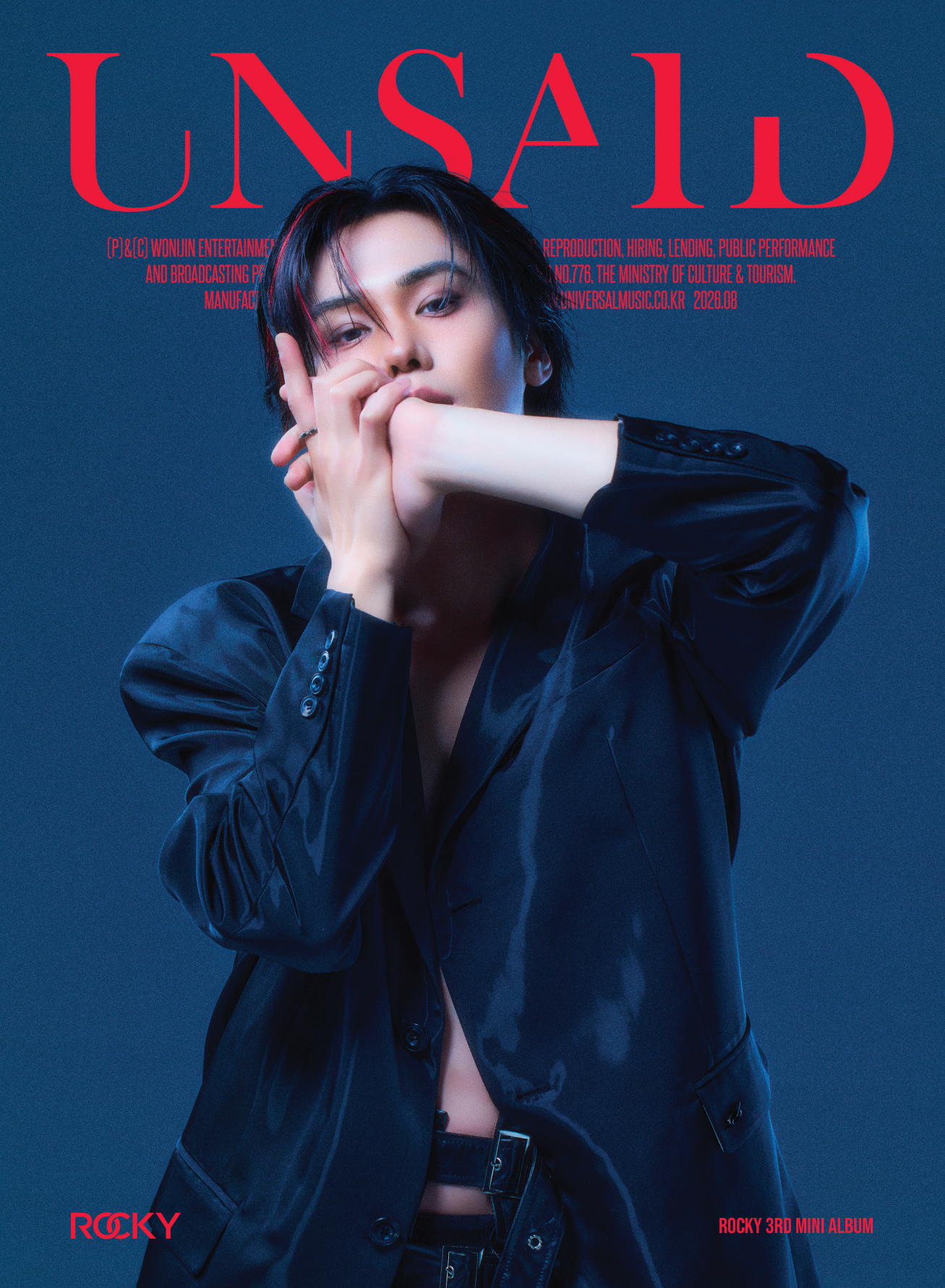
WONIJIN
ROCKY considers the past year a “blur” of creativity and motion. After releasing UNSAID in early August, he held his first concert in Korea in over a year, something he considers “a really special experience.”
“What I remember most,” he said, “is looking out at the audience from the stage and seeing how focused the fans were on the songs and on each moment.”
ROCKY’s relationship with his fans has “deepened” since he debuted as a soloist. These fans have watched him establish his own company – WONIJIN – and seen his evolution as an artist. They’ve also seen him shape cinematic music videos for tracks like “BA BA BYE” and release EPs that reveal deeper parts of his story: from how he’s handled grief (“BLANK”) to how music is integral to his identity (“Music Is My Life”).
Because his fans have been through so many major life changes, ROCKY says, “It feels like our relationship has gone beyond simply showing them a performance. It’s like we’re creating a [new] chapter together.”
ROCKY’s fans appreciate his honesty. He can be candid in interviews, but he’s particularly authentic in his music. I like that his lyrics can hold complex feelings and hard emotions, something he’s mastered since the release of BLANK. For UNSAID, ROCKY told me, “I tried to be as honest as possible about the stories I wanted to tell at this point in my life and the side of myself I wanted to show through the music.”
Perhaps the biggest change fans have seen firsthand is ROCKY stepping into leadership roles. When he founded WONIJIN, he became the CEO of his career. That responsibility also meant he took on roles staff often handled when he was an idol. But ROCKY found that the harder parts of the job remind him of why he loves being an artist. “As a creator, I think I became stronger because there were more decisions I had to make and take responsibility for,” he said. “Personally, even in the middle of such a busy period, it reminded me that what I love most is still making music and being onstage.”
Those instances can be challenging, but he told me, “When I actually see fans singing along to the songs or enjoying the performances, it feels like everything I went through during that process is being rewarded all at once.”
After a decade in his career, ROCKY was appointed Artistic Director of K-Pop Summit, where he will lead a new generation of K-pop trainees. There’s perhaps no better idol to mentor them than someone like ROCKY, given his history and experience in the industry.
“The biggest thing I’ve learned throughout my career is that, in the end, strong fundamentals and consistency are what last,” he reflected. “Finding your own identity is important, but before that, I think you need to build a strong foundation in whatever field you’ve chosen, whether that’s singing or dancing.”
Idols train like athletes to build the stamina to perform on stage and survive the long schedules they endure during a promotional period. None of that, ROCKY has learned, would be possible without a strong foundation or work ethic. “No one else can do that work for you,” he emphasized.
“What I would like to tell younger artists is not to try to see results too quickly, but instead to ask themselves every day whether they’ve improved, even a little, compared to the day before,” he said. “I also hope they never lose sight of the fact that having the opportunity to stand onstage is not something that should ever be taken for granted.”
ROCKY draws from that foundation daily as he creates music and plans performances for his fans. He sees his work on UNSAID as an example of how he’s grown to trust himself as an artist. “I want to keep expanding the range of music that feels convincing and authentic for me when I perform it,” he explained.
Ultimately, ROCKY hopes that when he looks back on this year, he sees that his choices moved him forward toward his goals. “Results are important too, but if the challenges I took on and the choices I made this year can become a foundation that allows me to be freer next year, then I think that alone will make 2026 a meaningful year,” he said.
He thought back to how exhausting planning his concert was and how much time and effort he put into making it a success. “I want to be able to acknowledge that even when there were difficult moments,” he said, “I took responsibility and followed things through to the end.”
ROCKY remembers how many minor details he had to tend to and how much pressure he felt to bring the music to life. He wanted it to feel authentic to him and his vision. But once the show started and he connected with the fans, all those thoughts disappeared. “It reminded me again, ‘This is why I perform,’” he said.
